Rajasthan · The Subcontinent
Dharatal
The earth of the tradition. Days inside the working life of Rajasthan's craft lineages, in courtyards and ateliers a stranger does not normally enter.
Rajasthan · The Subcontinent
The earth of the tradition. Days inside the working life of Rajasthan's craft lineages, in courtyards and ateliers a stranger does not normally enter.
The craft traditions of Rajasthan are not in decline. They are simply quiet. The families who inherited Nathdwara's pichwai painting from the Pushtimarg temple, the Bagru block-printers whose dye recipes have not changed in three centuries, the Manganiyar musicians whose desert ballads have never been transcribed. None of them advertise. They open their doors to people they know, and to people brought to them by someone they know.
Dharatal is not a tour of heritage sites. It is a fortnight of admission into work that is happening anyway, in the rooms where it happens, on the days the lineage holders themselves choose.
In the courtyard before the first call to prayer, four squirrel-hairs of pigment are mixed with gum that only sets in this air.
Nathdwara is the seat of the Pushtimarg, the devotional tradition founded by Vallabhacharya in the fifteenth century. Its pichwai paintings, large cloth panels depicting episodes from Krishna's life, were made for the temple and have never left its company. The painters are not commercial artists. They practise a devotional craft whose materials and gestures have not changed in three hundred years.
Bagru is a village thirty kilometres from Jaipur. Its block-printers, the Chippa community, work with natural dyes and hand-carved wooden blocks. The chemistry only behaves itself here. The mineral water, the particular clay used for resist-printing, the sequence of dye baths, together they produce colours that cannot be reproduced anywhere else, and the families who hold the recipes have been at it for a dozen generations.
The Manganiyar are a Muslim community of hereditary musicians whose patrons were the Hindu Rajput courts. Their repertoire, desert ballads, occasion songs, the long Jodhpur nights, has passed by ear for centuries. Almost none of it is written down.
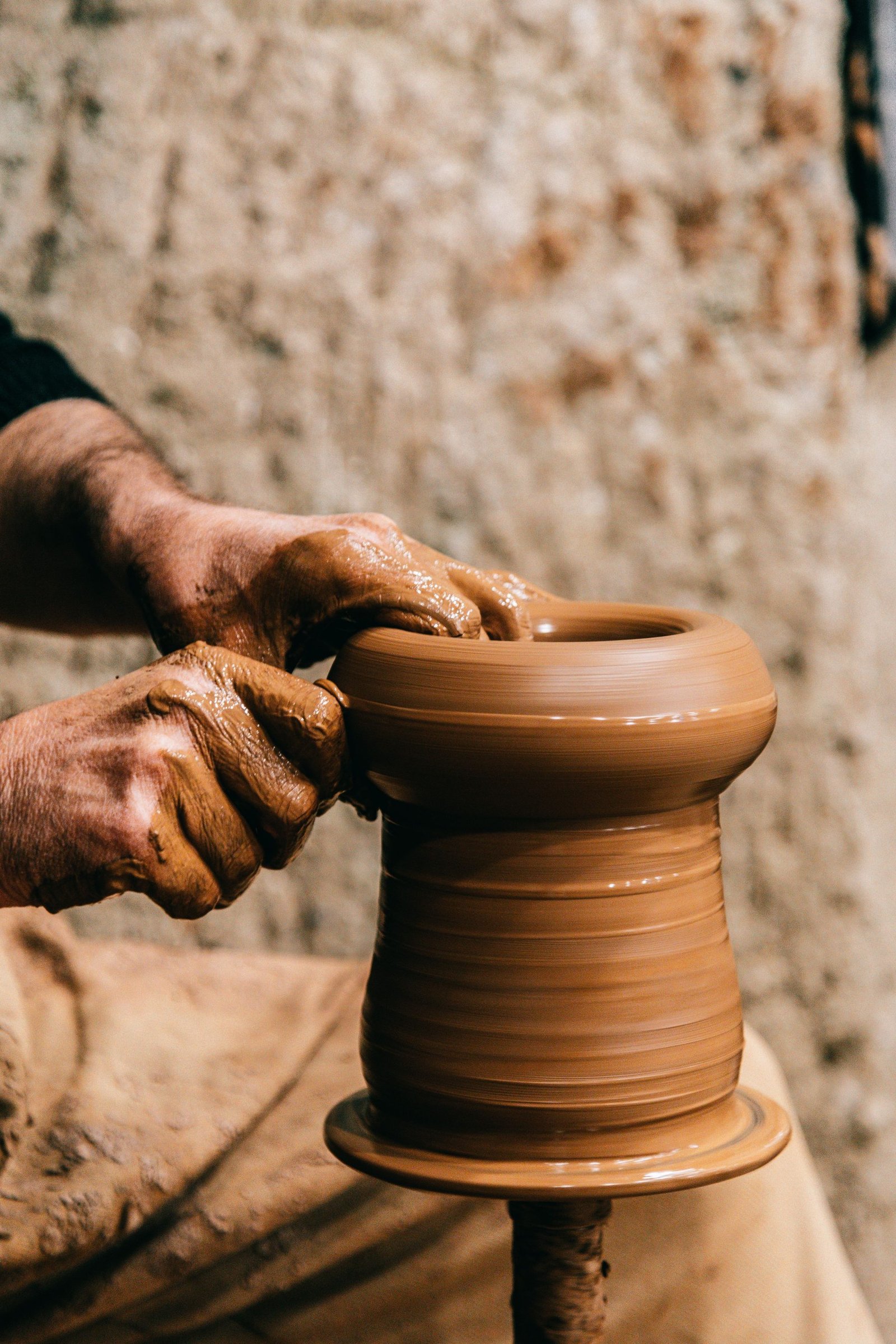
Rajasthan's craft is inseparable from its geography. The ochre of the sandstone, the mineral water, the very quality of the desert light. These are not background. They are the materials. A pichwai looks the way it does because the pigment only suspends properly in this air. A Bagru print holds its colour because the resist will only behave with this clay.
The sojourn moves between Nathdwara in the south, Bagru near Jaipur, and the Marwar country around Jodhpur where the Manganiyar live. The distances are short. The differences are large.
Dharatal opens at the Darshan register. You are present in each working room without being asked to perform a role inside it. Time with the painters in their light, with the printers between dye-baths, with the musicians the evening before the music begins. You are a guest, not a customer, not an apprentice. Up to four to a sojourn.
Autumn is when Rajasthan's festival calendar concentrates. Navratri, Diwali and the Nathdwara temple cycle all fall within a few weeks. New pichwais are commissioned, Manganiyar evenings multiply, and the craft houses move at a quicker rhythm than the rest of the year.
The climate is also at its best. The monsoon has lifted, the days are warm but not punishing, and the desert light is the kind that flatters even unflattering walls. We do not publish exact dates. The Custodian opens each sojourn in conversation with the lineage holders.
There is no minute-by-minute itinerary. The shape of a day is the shape the tradition asks for. Some mornings begin at the atelier before the light has fully arrived. Others are slower: a long conversation with a weaver, lunch shared in the workshop, an afternoon spent watching one process complete itself.
Manganiyar evenings are not concerts. They are sessions, played in the courtyards where the music belongs, for a small group who have been prepared to receive it. They end when the music ends.
The Custodian is with you throughout. Travel between locations is by private vehicle, unhurried. Meals are taken where the tradition is, not in hotels built for a different kind of visitor.
In Nathdwara, a heritage haveli, a private home rather than a hotel, in the older streets, within walking distance of the temple complex. In Marwar, a restored fort property outside the main city, chosen for the cultural landscape it sits inside rather than for any amenity ranking. The hospitality is considered. It is not the point.
Travel between is by private vehicle. Arrival is via Udaipur for the Nathdwara beginning, or Jodhpur for the Marwar extension. The Custodian holds the logistics. You only need to arrive.
He had been painting pichwais for forty years. The brushes he used were made from squirrel hair, four to seven hairs depending on the line required, and he made them himself. The pigments were ground from minerals specific to this region: the lapis came from Afghanistan by way of a family connection that had lasted three generations; the yellow from a plant whose name he did not translate, only demonstrated. He did not explain what he was painting. He painted. We watched. After two hours, without discussion, he made tea.
Dharatal opens through An Introduction. The Custodian will write back to you in person, before any proposal is made.
Begin An Introduction